DPDP Act compliance software: meet every requirement, and prove it

    Last updated: 15 October 2026

    VControl lists what the DPDP Act requires of your organisation, gives each task an owner, and stores the proof that it is done. One dashboard shows where you stand. We set it up for you, on our cloud or your own servers.

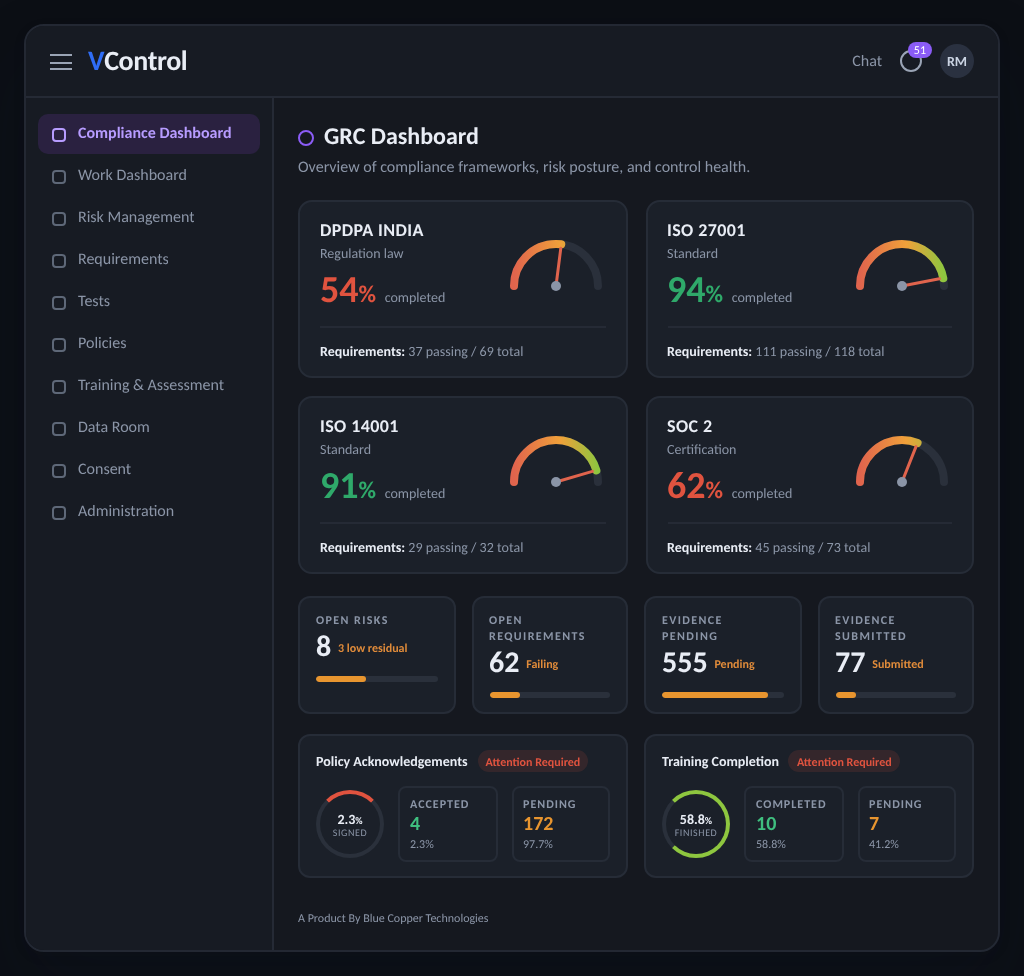
    VControl compliance dashboard screen
    What VControl covers

    Your obligations under the Act, and the module that carries each

    The DPDP Act sets out clear responsibilities. Here’s how VControl helps you meet each one, with the relevant section and the module that carries it.

    01s.5
    Itemised notice before collecting data
    Yes
    Notices & consent
    02s.4, 6, 7
    Lawful purpose: consent or a legitimate use, with records
    Yes
    Notices & consent
    03s.9
    Children’s data: verifiable parental consent
    Yes
    Notices & consent
    04s.8(3)
    Accuracy and completeness of data used
    Yes
    Data inventory & classification
    05s.8(5)
    Reasonable security safeguards, evidenced
    Yes
    Security governance
    06s.8(6)
    Breach intimation to the Board and individuals
    Yes
    Rights & breach response
    07s.8(7)
    Erasure when the purpose ends, respecting statutory holds
    Yes
    Retention engine
    08s.8(1), 8(2)
    Accountability for processors and vendors
    Yes
    Security governance
    09s.8(9), 8(10)
    Published contact point and grievance redressal
    Yes
    Rights & breach response
    10s.11–14
    Data principal rights: access, correction, erasure, nomination
    Yes
    Rights & breach response
    Also included

    More than core obligations

    VControl also helps you meet related duties, reporting needs, and common framework requirements—so you can do the work once.

    If you are a Significant Data Fiduciary

    The extra duties under s.10—a Data Protection Officer, periodic DPIAs and an independent data audit.

    Board reporting

    A readiness summary for your board, from the GRC dashboard.

    ISO 27001 and SOC 2

    A control you evidence for DPDP also counts toward these, so you do the work once.

    One set of controls across frameworks

    Where DPDP, ISO 27001, SOC 2 and other frameworks ask for the same thing, VControl maps it to a single control. You collect the evidence once, with no duplicate audits or paperwork, which saves your team time.

    Where it runs

    On our cloud or on your own servers.

    Set-up

    We implement it and onboard each department. This is part of the price, not an add-on.

    What you see in VControl

    What VControl shows your team

    Illustrative examples of the information VControl tracks for you every day: controls and their evidence, breach deadlines, and overall readiness.

    Control register

    live
    Access logs retained 12 months
    Head of IT · 3 artefacts · verified today
    Evidenced
    Breach runbook tested
    CISO · last tested 214 days ago
    Expiring
    Retention schedule applied
    Company Secretary · 6 artefacts
    Evidenced
    Processor terms in place
    Procurement · 2 of 19 vendors missing
    Gap

    Breach response

    active
    61h 24m
    Left of the 72-hour window
    0h24h48h72h

    Time remaining to file the detailed breach report with the Data Protection Board. Individuals notified · initial Board intimation sent · detailed report drafting

    Readiness

    updated 4 min ago
    78%

    controls evidenced and current across six departments

    DPDP Act
    78%
    ISO 27001
    91%
    SOC 2
    64%
    The output

    A live view of your whole organisation

    See how each department handles personal data at every stage, from collection to deletion. It stays up to date, so you can show it to your board at any time without preparing a separate report.

    Department
    Collection
    Capture
    Storage
    Processing
    Sharing
    Retention
    HR
    —
    !Retention
    IT & Security
    !Encryption
    Marketing
    !Policy
    —
    Customer Support
    !Access log
    —
    Legal & Compliance
    —
    Vendors & Processors
    —
    —
    !RBAC
    Evidenced and currentGap, owner and date assignedNot applicableIllustrative view
    Comparison

    How VControl compares with the alternatives

    Consultants, consent tools and global GRC platforms, side by side.

    What you needConsultantConsent-management toolGlobal GRC platformVControl
    Covers all DPDP obligationsAdvises, but no softwareConsent and notices onlyYes, once you configure itYes, built in
    Stores and checks your evidenceNo, kept in their filesConsent records onlyYesYes, checked on upload
    Works without cloud integrationsNot applicablePartlyNo, needs cloud connectionsYes, runs with your departments
    Reuses the work for ISO 27001 / SOC 2No, separate engagementNoYesYes
    Implementation includedYes, billed as consulting feesLimitedVia partners, extra costYes, included
    Can run on your own serversNot applicableRarelyRarelyYes
    How you payRecurring retainerPer consent or tiered planEnterprise licenceFixed first phase, then yearly subscription
    How implementation works

    How to achieve DPDP Act compliance in five steps

    Map your data

    Find where personal data sits in each department.

    Fixed price · the map is yours to keep

    Find the gaps

    Spot gaps in notices, consent, deletion and other rights, with a fix list and draft policies.

    Set up controls

    Consent, security, rights and retention, set up in VControl.

    Assign owners

    Every task gets an owner, a deadline and reminders.

    Stay compliant

    Live dashboard and audit-ready evidence, reviewed regularly.

    Ongoing

    Who does what

    Blue Copper, your advisor

    • Guides each department through its review
    • Reviews your evidence and flags what needs attention
    • Recommends fixes and helps you prioritise them

    Your team

    • One contact per department
    • Shares documents and screenshots
    • Makes the fixes

    VControl

    • Stores and checks evidence
    • Tracks every gap to closure
    • Sends alerts when something lapses
    Example: HR is asked for a blank onboarding form, to check it collects only the data it needs.
    Why Blue Copper

    How we keep your risk low

    A fixed price to start

    The first phase has a set fee and a clear deliverable. No open-ended bills.

    You keep what we build

    Your data map and records belong to you, whether or not you continue with us.

    Your servers, if you prefer

    Run VControl on our cloud or entirely on your own infrastructure.

    People make the final call

    AI speeds up the work, but a person reviews every finding before it counts.

    One point of contact

    A named engagement lead looks after your project from day one.

    Early-partner terms

    A limited number of organisations can join as early partners this year, on preferential commercial terms.

    01
    14 years

    Building mission-critical systems since 2012, with 300+ solutions delivered.

    02
    ISO 27001 / ISO 9001

    Certified to ISO 27001:2022 and ISO 9001:2015. We hold the standard we will ask you about.

    03
    150+

    Clients across India, the Middle East and the US, served from Kolkata and Delhi-NCR.

    04
    ISI

    Research partnership with IDEAS at the Indian Statistical Institute.

    Clients

    Organisations that trust Blue Copper Technologies

    Delivering Measurable Results Across Global Industries.


    Apparkotech logo
    CanPay logo
    Network Analysis logo
    IHCL logo
    Carbots logo
    FastPass logo
    OnlineKars logo
    UCA logo
    DivvyCloud logo
    ExhibitView logo
    Fareportal logo
    GOT Portal logo
    IIIM logo
    Selfrater logo
    DigiId logo
    Protiviti logo
    PointWorthy logo
    RedHammer logo
    RKM logo
    Activ8 logo
    Viridyan logo
    RCC logo
    HallMark logo
    Mali logo
    Empyx logo
    Nature Technologies logo
    Tradeco logo
    JMD logo

    Commercials

    DPDP compliance software pricing

    We share an indicative price range in our first conversation, so you can plan your budget early.

    01

    Phase one

    A fixed fee for the data map and registry. Scoped before you commit.

    02

    Implementation

    Priced from what the map finds, so you are not quoting blind.

    03

    Ongoing

    An annual subscription you can budget, not a per-consent meter.

    04

    What moves the number

    Systems and entities in scope, and how many departments hold personal data.

    05

    Where the saving sits

    Controls shared with ISO or SOC 2 are evidenced once, not three times.

    06

    Deployment

    Available on our cloud or your own servers.

    We will recommend the option that best fits your security needs and budget.

    Cloud (Recommended)
    Faster setup and lower maintenance.
    On-premise
    Full control within your infrastructure.
    Tailored to you
    We’ll help you choose the right fit.
    Frequently asked questions

    DPDP Act compliance: frequently asked questions

    Plain-English answers to the questions organisations ask most about India's Digital Personal Data Protection Act, 2023 and the DPDP Rules, 2025, followed by how VControl supports compliance. This FAQ explains the law and is not legal advice.

    For general product questions, visit the VControl FAQs.

    About the DPDP Act

    The Digital Personal Data Protection Act, 2023 (DPDP Act) is India's data protection law for how digital personal data may be collected, used, stored and shared. It received the President's assent on 11 August 2023 (Act No. 22 of 2023). It protects individuals' right to their personal data while allowing processing for lawful purposes. In practice, any organisation handling such data needs to know its duties.

    Source: DPDP Act, 2023, sections 1 and 3

    The Digital Personal Data Protection Rules, 2025 (DPDP Rules) are the rules that explain how the DPDP Act works in practice. Notified on 13 November 2025 (G.S.R. 846(E)), they cover notice contents, Consent Manager registration, security safeguards, breach reporting, children's data, individuals' rights and the Data Protection Board. People often search for them as the DPDP Act 2025, but the Act itself dates from 2023. Different rules start on different dates.

    Source: DPDP Rules, 2025, Rule 1

    The DPDP Act applies to processing of digital personal data inside India, including paper data digitised later. It also covers processing outside India when linked to offering goods or services to people in India. It does not apply to personal or domestic use, or to data the individual or a legally required person has made public. A foreign business serving Indian customers is covered.

    Source: DPDP Act, 2023, section 3

    Yes. The DPDP Act has no blanket exemption for startups or small businesses. Section 17(3) only allows the Government to exempt notified organisations, such as startups, from a few duties: notice, accuracy, erasure, Significant Data Fiduciary duties and the right to information. The DPDP Rules contain no such exemption (as of October 2026), so all duties apply.

    Source: DPDP Act, 2023, section 17(3)

    Most DPDP Act duties, including notice, consent, security safeguards and breach reporting, apply from 13 May 2027 (as of October 2026), eighteen months after the DPDP Rules, 2025 were notified on 13 November 2025. Data Protection Board provisions took effect on notification, and Consent Manager registration starts on 13 November 2026. In practice, organisations have until May 2027 to prepare.

    Source: DPDP Rules, 2025, Rule 1(2) to 1(4)

    Check where you stand: take the free DPDP readiness assessment

    The DPDP Act lets the Data Protection Board impose penalties of up to Rs 250 crore for failing to keep reasonable security safeguards. Failing to report a personal data breach, or breaching children's data duties, can cost up to Rs 200 crore. Significant Data Fiduciary (a large or high-risk organisation) duties are capped at Rs 150 crore, and most other breaches at Rs 50 crore.

    Source: DPDP Act, 2023, section 33 and Schedule

    Under the DPDP Act, a Data Fiduciary decides why and how personal data is processed, a Data Principal is the individual the data relates to, and a Data Processor handles data on a Data Fiduciary's behalf. For a child or a person with disability, the Data Principal includes the parent or lawful guardian. The Data Fiduciary stays responsible even when a Processor does the work.

    Source: DPDP Act, 2023, section 2

    A Significant Data Fiduciary under the DPDP Act is a Data Fiduciary, or class of them, that the Central Government notifies, based on factors such as data volume, sensitivity and risk. It must appoint an India-based Data Protection Officer and an independent data auditor, and under Rule 13 do a yearly impact assessment and audit.

    Source: DPDP Act, 2023, section 10; DPDP Rules, 2025, Rule 13

    The Data Protection Board of India is the body set up under the DPDP Act to enforce it. It inquires into personal data breaches and complaints, can direct urgent remedial steps, and imposes penalties after a hearing. It functions as a digital office, and its orders can be appealed to the Appellate Tribunal within sixty days.

    Source: DPDP Act, 2023, sections 18 to 29

    Under the DPDP Act, valid consent must be free, specific, informed, unconditional and unambiguous, given by a clear affirmative action, and limited to data needed for the stated purpose. It must follow a plain-language notice in English or an Eighth Schedule language (the 22 languages listed in the Constitution). Withdrawing consent must be comparably easy to giving it, and the organisation must be able to prove consent was given.

    Source: DPDP Act, 2023, sections 5 and 6; DPDP Rules, 2025, Rule 3

    The DPDP Act treats anyone under 18 as a child and requires a Data Fiduciary to get verifiable parental consent before processing a child's data. It bans processing likely to harm a child's well-being, tracking, behavioural monitoring and targeted advertising aimed at children. Rule 12 and the Fourth Schedule allow limited exceptions, for example for healthcare providers and educational institutions, but never for harmful processing.

    Source: DPDP Act, 2023, section 9; DPDP Rules, 2025, Rules 10 to 12

    Under section 5(2) of the DPDP Act, an organisation may keep processing data collected with consent before the Act, until the person withdraws consent. It must, as soon as practicable, send a notice covering the data, the purpose, how to exercise rights and how to complain to the Board. The erasure duty still applies once the purpose is no longer served.

    Source: DPDP Act, 2023, section 5(2)

    Yes. Section 16 of the DPDP Act lets the Central Government restrict transfers only to countries it notifies, and Rule 15 allows transfers subject to any requirements it specifies for making data available to foreign States and their agencies. Stricter Indian laws still apply, and Significant Data Fiduciaries may be required to keep specified data in India. In practice, check notified countries and sector rules first.

    Source: DPDP Act, 2023, section 16; DPDP Rules, 2025, Rule 15

    Under section 8(7) of the DPDP Act, a Data Fiduciary must erase personal data once consent is withdrawn or the purpose is no longer served, unless a law requires retention. Rule 8 and the Third Schedule set a three-year inactivity period for large e-commerce, online gaming and social media platforms, with 48 hours' warning before erasure. Personal data, traffic data and processing logs must be kept for at least one year.

    Source: DPDP Act, 2023, section 8(7); DPDP Rules, 2025, Rule 8

    Under the DPDP Act, a Consent Manager is a person registered with the Data Protection Board who acts as a single point of contact for individuals to give, manage, review and withdraw consent through an accessible, transparent and interoperable platform, accountable to the individual. Among other conditions, applicants must be companies incorporated in India with a net worth of at least Rs 2 crore.

    Source: DPDP Act, 2023, sections 2(g) and 6; DPDP Rules, 2025, Rule 4

    The DPDP Act gives individuals the right to access a summary of their personal data and who it was shared with, to correct, complete, update or erase it, and to have grievance redressal. They can also withdraw consent at any time and nominate someone to act for them on death or incapacity. Use the grievance process before complaining to the Board.

    Source: DPDP Act, 2023, sections 11 to 14

    Under the DPDP Act and Rules, an organisation must tell the Data Protection Board about a personal data breach without delay, then send detailed information within 72 hours of becoming aware, or a longer period the Board allows on written request. It must also tell each affected individual without delay. These duties apply from 13 May 2027 (as of October 2026).

    Source: DPDP Act, 2023, section 8(6); DPDP Rules, 2025, Rule 7

    The DPDP Act differs from the EU's GDPR in several ways. It covers only digital data. It allows processing on consent or listed legitimate uses, while GDPR Article 6 lists six lawful bases including legitimate interests. DPDP penalties are fixed rupee caps up to Rs 250 crore, while GDPR fines reach EUR 20 million or 4% of worldwide annual turnover, whichever is higher.

    Source: DPDP Act, 2023; GDPR Articles 6 and 83

    Organisations can start complying with the DPDP Act by mapping the personal data they hold and why. Then they should issue clear notices and record consent, sign contracts with processors, apply security safeguards, prepare a breach response, set up a grievance process with published contact details, and plan erasure of data no longer needed. Extra care applies to children's data.

    Source: DPDP Act, 2023, sections 5 to 9

    About VControl for DPDP

    VControl helps organisations prepare for the DPDP Act: it can map the Act's sections, rules and obligations to requirements, tests, evidence, risks, findings, owners and corrective actions. Its registers, workflows, dashboards, reminders and audit trail help you assess readiness and keep the evidence. The proposed DPDP scope includes Data Processing, Processor, Notice, Retention, Data Principal Request and Breach registers. The exact ready-to-use fields, workflows and reports must be confirmed for the proposed release.

    See VControl compliance management software

    VControl governs DPDP Act privacy notices and consent records: notice versions, purposes, data categories, owners, approvals and supporting consent records. Capturing consent for each transaction, enforcing withdrawal, or operating as a registered Consent Manager requires specific product scope or integration with your applications and consent systems.

    Yes. VControl can be deployed in your own private cloud or on-premise environment, or used as a managed cloud service. Customer-controlled deployment can address stricter data residency needs, and data location, retention and deletion are agreed in the contract and deployment design. Integration and AI options may differ by deployment model.

    No. VControl does not provide a government certification or a guarantee of DPDP Act compliance. It supports continuous readiness assessment, evidence, monitoring, rights workflows and remediation, while your organisation remains accountable for compliance and should get legal or privacy advice on interpretation.
    Next step

    Book a 30-minute walkthrough

    Share your requirements and we will show you how VControl meets them. You will leave with a clear view of fit and an indicative price range.

    Loading…